Ronald Bunting
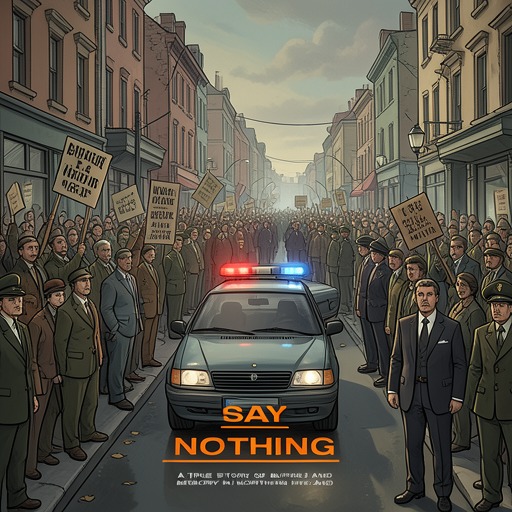
Say NothingRonald Bunting, a former British Army officer and high-school mathematics teacher known as Major Bunting, became the leader of the loyalist counterprotest against the civil-rights march from Belfast to Derry. His role culminated at Burntollet Bridge, where the marchers were ambushed: he had urged his followers to arm themselves with whatever protection they considered suitable, and was present as attackers beat people and seized a protest banner. The episode joined public political agitation to physical intimidation, while a family divide inside the march gave his opposition a sharply personal dimension.
Identity and Political Alignment
At forty-four, Bunting was a stout former army officer whom his followers called the Major. He had once held more progressive views, but came under the influence of Ian Paisley after Paisley attended to Bunting’s dying mother. Bunting was also an Orangeman, belonging to a Protestant fraternal organization defined by opposition to the Catholic population. By the time the march passed through Belfast, he had become its counterprotest’s principal organizer and spokesman.
Bunting’s politics belonged to a period of deep uncertainty about Northern Ireland’s place in the United Kingdom. Protestant unionists feared that Catholics would eventually outnumber them, while many in Britain seemed indifferent to the province or willing to see it go. For especially committed loyalists, that uncertainty could make defense of British identity feel like a last line of resistance. Bunting’s conduct was not simply opposition to a particular procession: he and his supporters treated the march as a threat to a political and communal order they believed must be defended.
His answer to a journalist who asked whether it might be better to leave the marchers alone made the division plain: Bunting compared ignoring them to ignoring the devil. The language transformed a political demonstration into a moral danger. That framing would recur in the preparations for the march’s final day, when Paisley portrayed its civil-rights advocates as disguised members of the Irish Republican Army and invoked Derry’s history as a Protestant stronghold.
The Counterprotest and Family Division
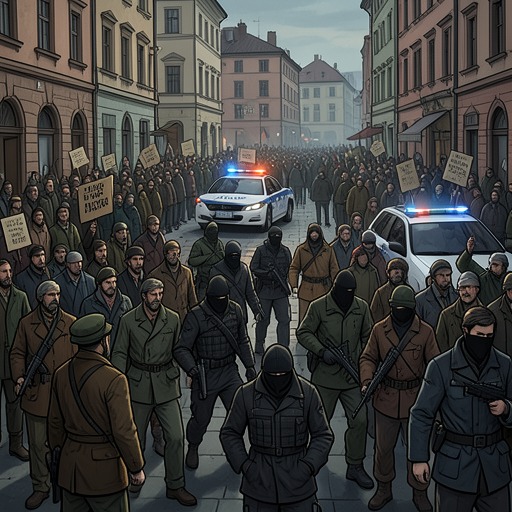
From the march’s departure at Donegall Square, Bunting’s supporters harried the demonstrators, jostling them, jeering, and trying to take their banners. They raised the Union Jack against the marchers’ signs, making the confrontation visible as a contest over national allegiance as well as civil rights. Bunting led the opposing group while its members pursued a campaign of harassment and shouted anti-Catholic abuse through a megaphone.
Among the marchers was Bunting’s son Ronnie, a student at Queen’s University Belfast who had moved toward radical politics during the summer of 1968. He, too, had joined People’s Democracy. The younger Bunting was hardly the only Protestant on the march; the movement for Irish independence had included Protestants before him. But his presence made the confrontation unusually intimate: his father was organizing the very counterprotest that followed and harassed him. Ronnie complained to friends, shamefaced, that his father was making a fool of himself. The narrative suggests that the division sharpened the resolve of both men rather than drawing them together.
The family conflict also complicates any simple division of the march into Protestant opponents and Catholic demonstrators. The son’s participation showed that Protestant identity did not dictate support for unionism, even as the father’s leadership drew on a politics that presented the march as an assault on Protestant security. Their opposing positions were enacted in public, on the same road, with each attached to a different procession.
Preparing for Burntollet Bridge
On the night before the marchers’ final day, while they slept on the floor of a hall in Claudy, Bunting assembled loyalist followers in Derry. Hundreds gathered in the Guildhall for a meeting billed as a prayer meeting, where Ian Paisley was ready to address them. Paisley invoked the city’s history as a bulwark against Catholic advance and encouraged the crowd to see the approaching march as a renewed challenge to that legacy.
Bunting acted as Paisley’s designated adjutant. After Paisley had whipped the gathering into enthusiasm and receded from the scene, Bunting told those who wished to play a manly role to arm themselves with whatever protective measures they considered suitable. That instruction gave practical force to the meeting’s rhetoric. During the night, local men gathered sizable pieces of freshly quarried rock in fields above the road; a sympathetic farmer supplied a tractor to help move the stones, which were placed at intervals for an ambush. The account does not say that Bunting personally collected or placed the stones, but it identifies him as the leader who directed the crowd toward preparation for confrontation.
The marchers proceeded nonviolently toward the bottleneck at Burntollet Bridge, where the road narrowed beside the River Faughan. Their numbers had grown to hundreds. Before they reached the bridge, a man appeared on the ridgeline wearing a white armband and making elaborate hand signals; other figures emerged along the field above the road. Stones came down, and attackers then ran toward the marchers carrying cudgels, crowbars, lead pipes, laths, and planks studded with nails.
The Ambush and Its Significance
The marchers did not fight back. They had agreed beforehand to honor their commitment to nonviolence, even as people were knocked down, kicked, and injured. A young girl was struck on the head with a spade; newspaper photographers were beaten and stoned, their film taken, and they were threatened with death if they returned. In the midst of the assault, Bunting acted as grand marshal, swinging his arms like a conductor. His coat sleeves were stained with blood. He snatched a banner from the protesters, and someone set it alight.
Bunting’s presence at the attack makes him more than a remote political agitator in the account. His earlier leadership, his instruction to arm, and his conduct amid the violence form a sequence in which denunciation prepared the crowd for confrontation. Still, the narrative distinguishes his documented actions from those of the attackers: it does not say that he personally struck the marchers. His role is instead shown through direction, presence, and the seizure of a banner as the procession’s pledge of nonviolence was met by organized force.
The response of the police further darkened the scene. An officer from the Royal Ulster Constabulary eventually waded into the river to break up the violence, and Dolours Price clung to his coat as he helped her toward safety. Yet dozens of officers had been present, and most had done little to intervene. It was later alleged that attackers wore white armbands so police allies could distinguish them from the marchers; many of Bunting’s men were members of the police auxiliary, the B-Specials. The attack therefore revealed not only the vulnerability of the marchers but also the blurred boundary between loyalist mobilization and the forces expected to protect them. Bunting stands at the center of that exposure: a leader who presented the march as a danger to be confronted, helped prepare the confrontation, and was visibly present when intimidation became assault.